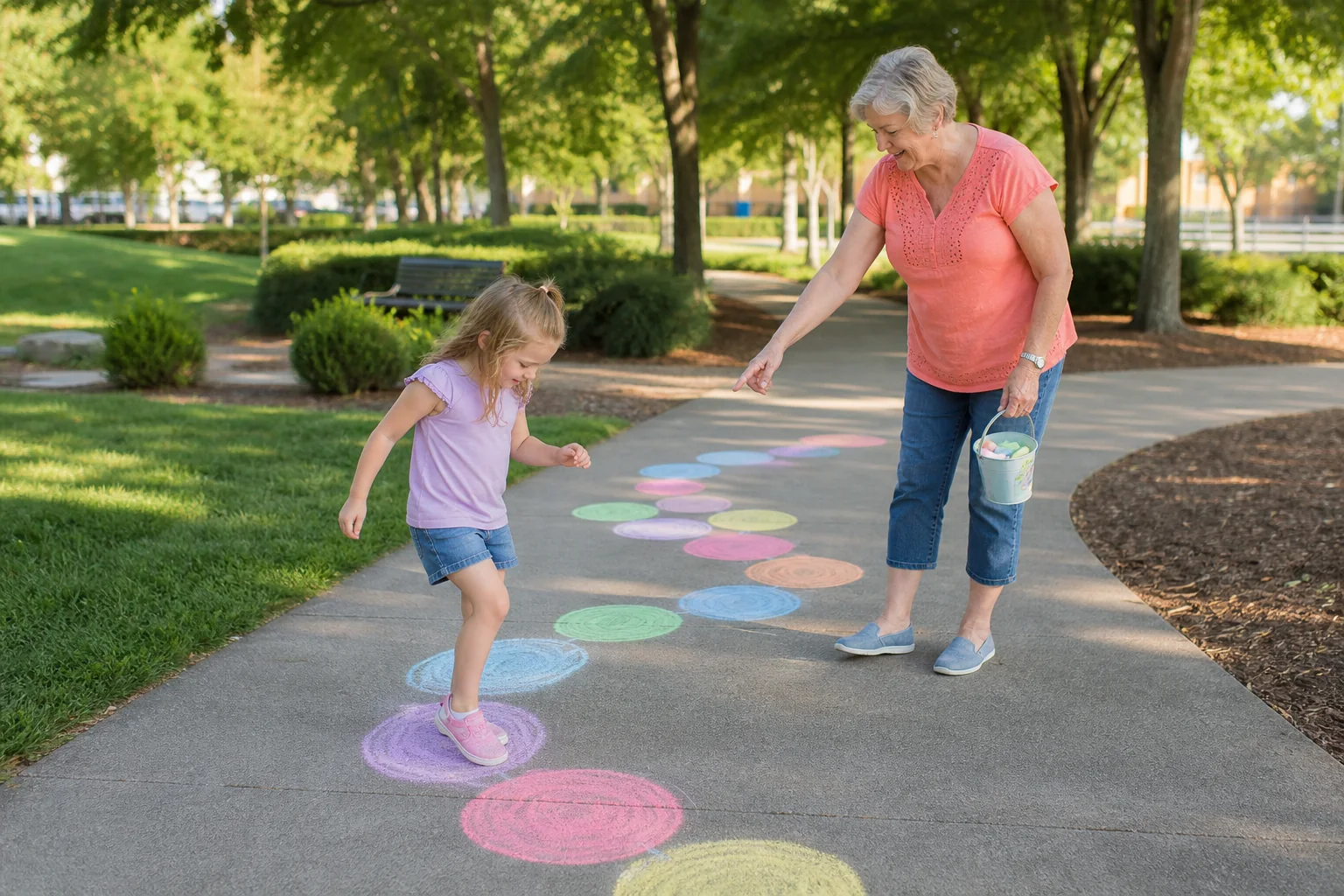
Choose a permitted, traffic-free paved area, draw one game, and play it before filling the whole surface. Chalk marks should never send children into a street, active parking lot, bike lane, driveway used by vehicles, or across an entrance people need to use.
Four games can start with chalk alone. You will also need rolled socks or a beanbag for the target toss, and a light playground ball for four square.
Pick a game by age and group size
| Game | Players | Easy starting age | Extra item |
|---|---|---|---|
| Color call path | 1 or more | preschool | none |
| Shape switch | 2 or more | preschool | none |
| Open-choice hopscotch | 1 or more | preschool and up | marker optional |
| Three-ring target | 1 or more | preschool and up | beanbag or rolled socks |
| Line maze | 1 or more | any child who can follow a route | toy car optional |
| Four-square starter | 2–4 | school age; simplify for younger children | playground ball |
Age is only a starting point. Use the version that matches how the child moves and understands the rules today.
Game 1: Color call path
Draw eight large circles in three or four colors. With more than one player, take turns or give each child a separate path. Do not race for the same circle.
One person calls a color. The player moves to the nearest matching circle. Change the movement each round: walk, tiptoe, take giant steps, or step sideways.
Easier version: Use two colors and let the child point before moving.
Older-child change: Call a sequence such as “blue, red, yellow.” The player has to remember and visit the circles in order.
For seated play or limited movement, draw the circles within comfortable reach and use hand taps, a beanbag, or a toy to mark the called color.
Game 2: Shape switch
Draw two of each shape: circle, square, triangle, star, and heart. Spread the pairs across the play area and use at least two chalk colors.
One child stands on a shape while another calls, “Switch to the same shape,” “find a shape with corners,” or “move to something different.” The child moves to another shape that fits the clue. After three calls, swap roles. With a larger group, use one mover at a time and take turns calling.
Easier version: Draw only circles and squares.
Older-child change: Give two conditions: “Find a shape with four sides that is not blue.”
Do not eliminate children who choose the wrong spot. Name the feature they found, redraw an unclear shape if needed, and start the next round.
Game 3: Open-choice hopscotch
Draw a path of ten boxes. Mix single and side-by-side boxes, but make them large enough for the players using them. Put a color, shape, dot pattern, or number inside each box.
Players travel from start to finish. They can step with two feet, hop on single boxes, or choose their own movement. The rule is to land inside each box without rushing into the next player.
Easier version: Skip throwing a marker. Walk the path and name each picture.
Traditional change: Toss a flat marker onto a box, skip that box on the way out, and pick up the marker on the return. Use this only when players can throw and retrieve it without crowding. Playworks explains the full marker rules if children want a standard round.
Older-child change: Add a direction inside some boxes: turn, clap twice, balance, or name a word that begins with a chosen letter.
Game 4: Three-ring target
Draw three large circles inside one another. The outer zone is worth one point, the middle zone two, and the center three. Mark a throwing line.
Each player tosses a beanbag or rolled pair of socks three times. Score the zone where the object stops. If it touches a line, count the lower score. Collect the objects only after all three throws. Move the throwing line closer for younger children.
No-score version: Call a ring color and try to land the object there.
Older-child change: Play three rounds from three distances and add the totals.
Keep the throwing direction away from windows, people, pets, and parked vehicles.
Game 5: Line maze
Draw two parallel lines to make a wide path with several turns. Add one or two dead ends and a finish symbol. Keep the route wide enough for the person, toy, stroller, or mobility device using it, and do not block the regular accessible path through a public space.
Players follow the maze without crossing the chalk lines.
Easier version: Use one winding line and follow it with feet, a finger, or a toy car.
Older-child change: One player adds a safe detour while the other waits, then they switch roles.
A child can also direct an adult through the route using “left,” “right,” “forward,” and “stop.”
Game 6: Four-square starter
Draw one large square divided into four equal boxes. One player stands in each box. Use a light playground ball.
The server drops the ball, lets it bounce in their own square, then taps it with an open hand into another player’s square. The receiver lets it bounce once in their square, then taps it directly into someone else’s. Stop and restart when the ball leaves the court, bounces twice, or cannot be returned safely. With three players, leave one square empty and aim only for occupied squares.
Two-player version: Use two opposite boxes and aim only for each other’s square.
Younger-child change: Catch the ball after one bounce, then roll or underhand-toss it to another square.
Older-child change: Keep the one-bounce rule and rotate the server after five successful passes rather than eliminating players.
Make the surface part of the decision
Before drawing:
- check that chalk is permitted
- keep a clear route past the game
- avoid loose gravel, broken pavement, wet patches, and steep slopes
- test whether the surface feels too hot for hands or seated play
- choose a spot where adults can see approaching bikes and vehicles
- keep chalk and game pieces out of drains, landscaping, and water features
Use the first game as a surface test. If the chalk barely marks, the ground is uncomfortable, or the area becomes busy, pack up without drawing the other five.
Photograph the board, then pack up
Take a photo if children want to remember the board. Collect chalk, balls, beanbags, and other pieces. Follow the property’s cleanup rules. Some places expect rain to remove chalk. Others ask visitors to wash it away.
Do not promise that every mark will disappear immediately. Test a small spot before using chalk on a home surface that stains easily.
Frequently asked questions
What games can children play with sidewalk chalk?
Try a color call path, shape switch, hopscotch, a target toss, a line maze, or a simplified four-square court. Draw one game first and add another only when children are ready to switch.
What chalk games work for preschoolers?
Large color circles, simple shape matching, walking hopscotch, close-range target tossing, and a single winding line. Short rules, no reading required.
What can two children play?
They can alternate calling colors, make shape clues for each other, take turns on a target, build a line maze together, or play the two-square version of four square.
How do I simplify hopscotch?
Remove the throwing marker and let children walk or hop through large boxes in their own way. Use colors or pictures when numbers are not useful yet.
Can a child play without jumping?
Yes. Every game on this page can use walking, reaching, rolling, pointing, or moving a toy. Adjust the spacing and route for the person playing.
Where should we use sidewalk chalk?
A permitted, traffic-free paved area where the game will not block doors, sidewalks, accessible routes, bike lanes, or regular vehicle movement.