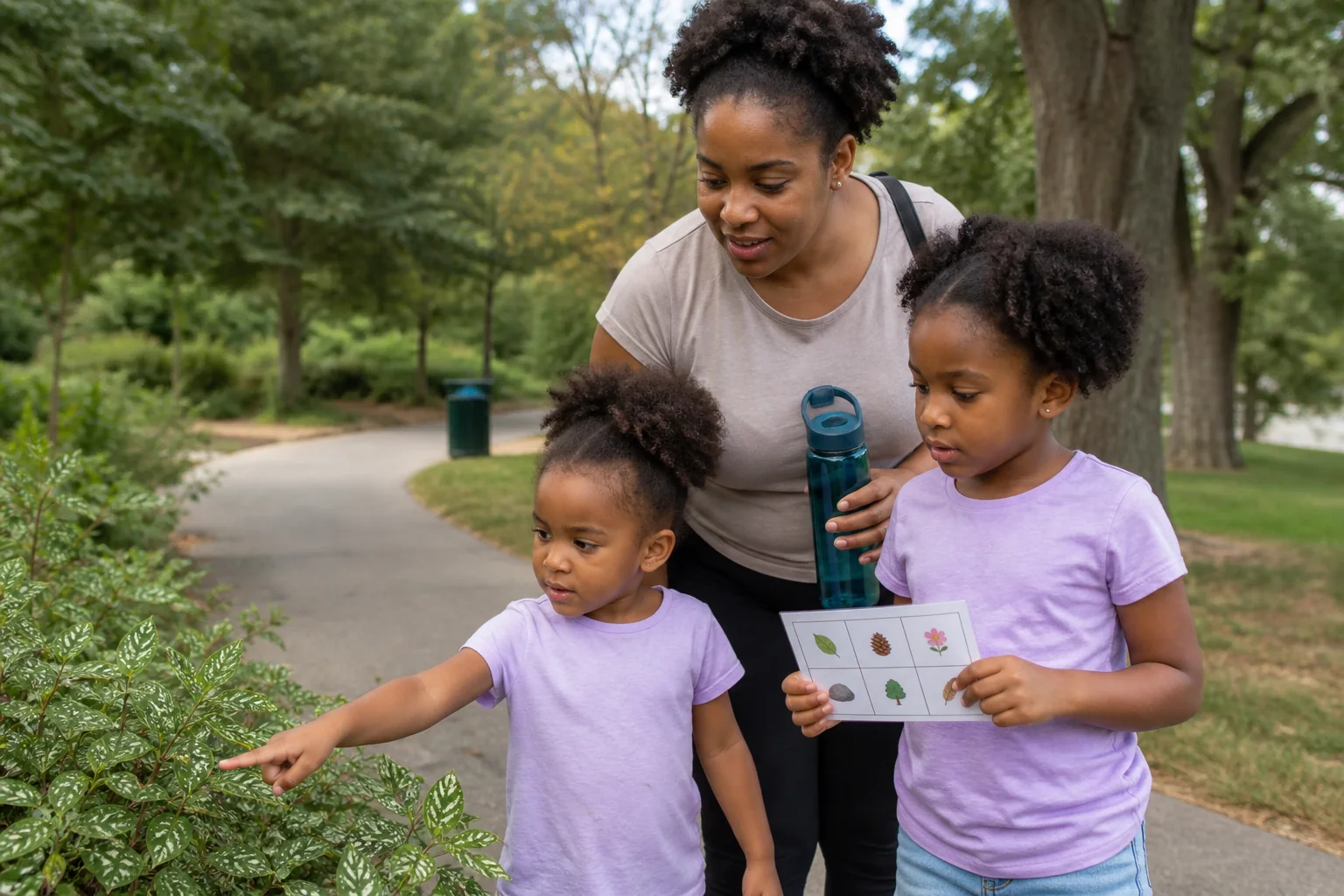
Pick one hunt below, set a boundary, and start. For a young child’s first round, choose six clear finds rather than a long picture sheet. Older children can take photos, write clues, or run the next round.
Nothing needs to come home. Point, photograph, sketch, or describe each find, then leave it where it belongs.
Set three rules before the search
Tell everyone:
- Where the hunt ends. Use a fence, path corner, playground gate, or the adult walking in front as the boundary.
- What stays outside. Plants, animals, nests, feathers, rocks, and park property stay where they are unless posted rules clearly allow collecting.
- What “found” means. A point, photo, drawing, or spoken description counts. Nobody has to touch an item.
Choose one meeting spot in case children spread out. At a public park or trail, children stay within sight of their adult throughout the game.
Hunt 1: The 10-minute point-and-find hunt
This version works for preschoolers and children who do not read yet. Read one clue at a time.
Find:
- something yellow
- something taller than you
- something with a rough surface
- something that moves in the wind
- a round shape
- a tiny living thing you can watch without touching
- two things that make different sounds
- a place an animal could hide
- something that was made by a person
- the way back to the starting spot
Stop after six finds if attention is fading. Save the remaining clues for another walk. For a child who likes repetition, use the same list on a different day and notice what changed.
Hunt 2: A photo hunt for mixed ages
One phone or camera is enough. An adult can hold it while children choose the pictures.
Take a photo of:
- three shades of the same color
- a shadow with an interesting shape
- one object that looks very old and one that looks new
- a pattern made by nature
- a sign that people use the area
- something an animal may have left behind
- a view taken from low to the ground
- everyone’s favorite find at the end
School-age children can frame the photo and give it a short title. Younger children can choose the subject. If two children want the camera, alternate turns instead of racing to the next clue.
Do not photograph strangers closely without permission. Keep the phone put away while crossing a street, parking area, bike path, or uneven section of trail.
Hunt 3: The make-a-clue hunt
Use this when children already know the area.
The first player gives a clue without naming the object: “Find something green that makes shade.” Everyone looks. The person who finds it gives the next clue.
Clues can use:
- color
- shape
- size
- sound
- location
- what the object does
- what it reminds the child of
For younger children, offer two choices: “Should we find something smooth or something noisy?” For older children, ban color words for one round, or ask for a clue with two details.
This hunt needs no prepared list and can continue on the walk home.
Choose clues for the place you have
| Where you are | Useful clues | Leave out |
|---|---|---|
| Backyard or shared courtyard | fence shapes, shadows, safe plants, outdoor tools | anything beyond the agreed boundary |
| Neighborhood sidewalk | house numbers, tree bark, mailboxes, sidewalk patterns | clues that send children toward traffic or private yards |
| Playground | colors, signs, surfaces, sounds, shapes in equipment | climbing or running challenges disguised as clues |
| Paved park path | benches, birds, leaf shapes, water, trail symbols | collecting plants or stepping off the route |
| Nature trail | tracks, bark, fallen branches, habitat signs, distant wildlife | touching animals, nests, fungi, or unknown plants |
A stroller, wheelchair, or shorter walking route can use the same visual and sound clues. Keep every item visible from the planned route rather than sending one child off the path.
Give mixed-age children different jobs
One shared list works when the jobs are different:
- Youngest child: points or chooses between two clues.
- Older child: reads the clue, keeps count, or takes the photo.
- Adult: stays with the group, keeps children inside the boundary, and handles the phone near roads or water.
- Next-round leader: chooses the final clue for everyone.
Do not make speed the main rule. The fastest child will control the game, and the careful observers will stop looking. If children want a score, give one point for a clear description or an unusual observation, not for arriving first.
What to do when a clue is not there
Do not keep walking far past the planned route for one missing item. Use one of these:
- swap it for the same color or shape
- photograph the place where it might appear in another season
- let the child invent a replacement clue
- mark it “not today” and move on
Weather, maintenance, and season change what is visible. Keep the missing clue for a later visit if the child wants to try again.
End before the walk home becomes the hard part
Announce the final two clues, return to the starting spot, and let each child choose one favorite find. Have water or a snack where food is permitted, then put the list away.
For a longer outing, use the hunt only on the first half of the route. Children still need attention and energy for the return. The National Park Service has more backyard observation prompts if you want a different list another day.
Frequently asked questions
How do I make an outdoor scavenger hunt for young children?
Use six to ten clues based on color, shape, sound, size, and location. Read one clue at a time, keep the route short, and accept pointing or describing as a find.
What can children find without collecting anything?
Colors, shadows, sounds, patterns, textures, animal hiding places, signs, and objects that are taller, smaller, older, or newer than something else. Use photos or drawings when they want a record.
Can children who do not read play?
Yes. An adult or older child can read each clue aloud. Use simple choices and visual clues rather than a printed word list.
How do siblings of different ages play together?
Give them different jobs. A younger child can point, an older child can read or photograph, and both can take turns making the next clue.
What if we cannot find an item?
Swap the clue, invent a replacement, or mark it “not today.” Stay on the planned route rather than stretching the outing for one missing find.
What should we bring?
The spoken point-and-find hunt needs nothing. For other versions, bring a phone or camera, a pencil and small notebook, water, and the usual weather items for your route.