Guide 1
What to look for first
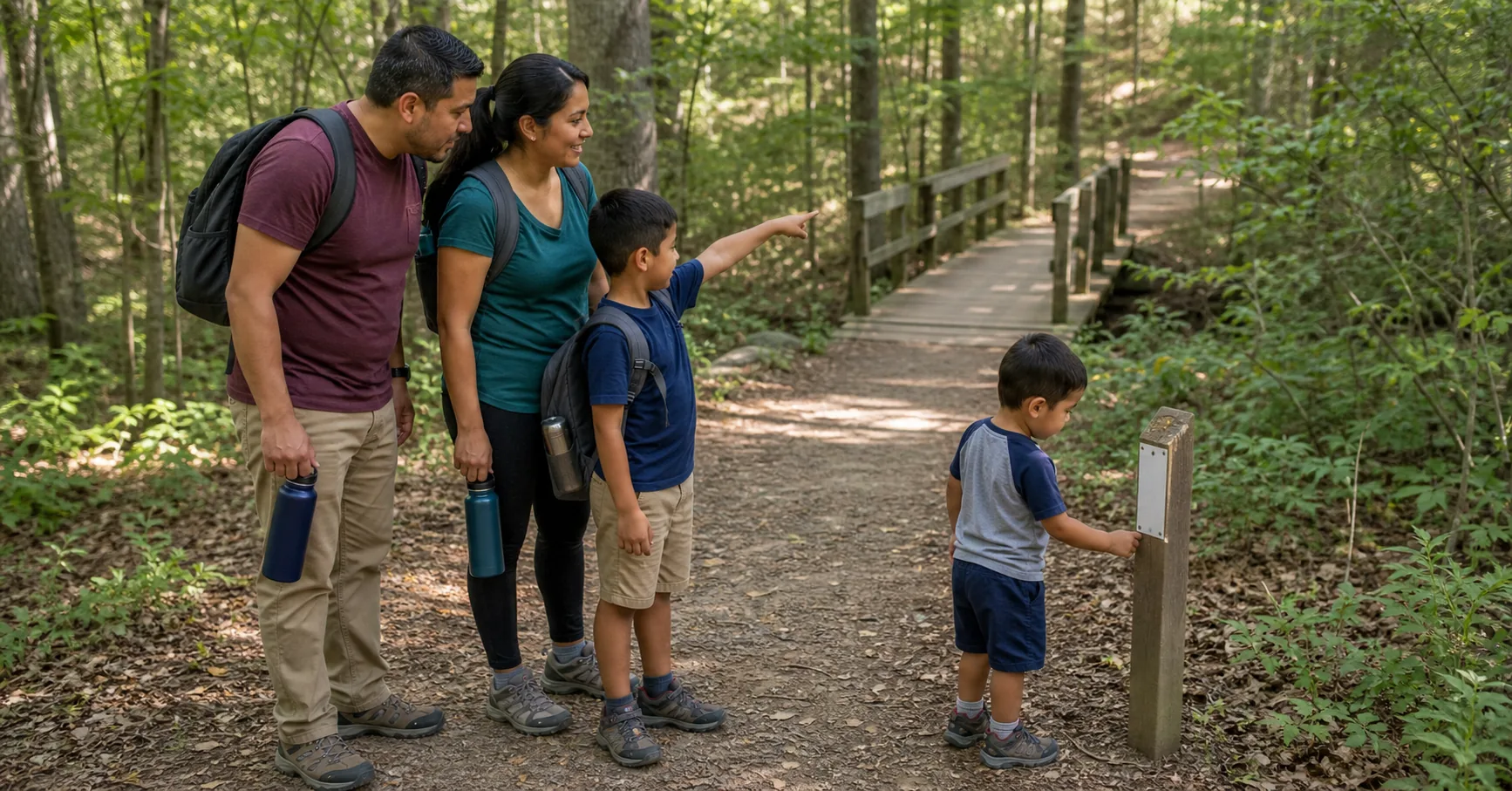
For a first family hike, look for a short out-and-back trail or a flat loop with a clear turnaround, modest elevation change, a firm surface, and something children can notice early. Water, bridges, big rocks, signs, birds, and a visitor center can keep a simple walk moving.
Check the official land manager’s current trail page for closures, weather, parking, fees, wildlife notes, and conditions. Bring water, snacks, sun or rain protection, shoes that work on the surface, and a small first-aid kit.
Keep children in sight. Turn around before the group is worn out.
Quick checks
- Choose a short out-and-back or flat loop.
- Use the official land manager’s current trail page.
- Pack water, snacks, weather protection, and first-aid basics.
Guide 2
Read the description like a parent
Distance is only the first number. Check the total distance including the walk from parking, elevation gain and where it happens, surface, exposed edges, water crossings, steep steps, shade, bathrooms, cell coverage, route markings, and whether you can turn around anywhere.
A one-mile trail with steep, loose footing can be harder than a two-mile paved loop. Read recent official notices and current condition reports, not only the difficulty label.
Quick checks
- Include the walk from parking in the total distance.
- Check elevation, surface, edges, crossings, and steps.
- Confirm shade, bathrooms, cell coverage, and route markings.
Guide 3
Pick the trail for the youngest walker
Toddlers may walk ten minutes, stop to inspect gravel, and ask to be carried. Preschoolers often do better with a mission and a destination they can see.
School-age children may handle more distance and still need water, snacks, and a reason the trail feels worth it. For a toddler, choose a stroller-friendly route or a short path close to the car.
If you plan to use a carrier, decide how far you can comfortably carry them on the way back. For preschoolers, try a loop with bridges, signs, water, animal tracks, or a visitor center.
For older children, add navigation, a Junior Ranger activity, a photo challenge, or the job of finding the next marker. Do not use an older sibling’s stamina as the standard for the whole family.
Quick checks
- Keep toddlers close to the car or on a stroller-friendly route.
- Give preschoolers a visible destination or small mission.
- Let older children help find markers or navigate.
Best options by situation
| Situation | Best option | Why it works | Watch out for |
|---|---|---|---|
| First hike with young children | Short out-and-back | You can turn around at any time | Adults may keep going too long |
| Stroller or wheelchair needed | Paved path or firm boardwalk | The surface is easier to predict | Accessible may cover only one section |
| Children need a goal | Trail to a bridge, pond, or overlook | The route has a clear reason | The destination may have water or drop-offs |
| Hot day | Shaded low-elevation loop | Less sun and an easier return | Shade does not cancel heat |
| Recent rain | Paved or well-drained route | Less mud and slipping | Boardwalks and rocks can still be slick |
| Mixed ages | Visitor-center loop with an optional extension | Younger children can stop while others continue with an adult | Agree on the meeting point and turnaround first |
Guide 4
Match the trail to the day
Heat, recent rain, mixed ages, and mobility needs can change which route works. A shaded loop can reduce direct sun but does not cancel heat.
A boardwalk may avoid mud but can still be slick after rain. For mixed ages, a visitor-center loop with an optional extension lets younger children stop while another adult continues with older children.
Agree on the meeting point and turnaround before anyone splits up.
Quick checks
- Use a shaded low-elevation loop on a warm day.
- Choose pavement or good drainage after rain.
- Agree on meeting and turnaround points for mixed ages.
Guide 5
Waterfalls need extra checking
Children like a destination. Waterfall trails also deserve more caution than an ordinary park loop.
Check stream crossings, wet rock, railings, cliff edges, seasonal flow, and whether the return climbs uphill. Keep children close near water and edges.
A safe viewing spot matters more than getting to the closest possible rock. If the waterfall only runs after heavy rain, the trail may also be muddier, faster-flowing, or more slippery than the photos.
Quick checks
- Check crossings, wet rock, railings, and cliff edges.
- Confirm current flow and whether the return climbs uphill.
- Use the safest viewing spot instead of the closest rock.
Guide 6
Stroller-friendly is not the same as easy
A paved trail can still have a long grade, broken surface, a narrow gate, a crowded boardwalk, or steps at the feature you came to see. Confirm which section is usable, where accessible parking starts, whether the bathroom route is also step-free, and whether the stroller can turn around.
For air-filled tires, watch for thorns and sharp gravel. For small wheels, boardwalk gaps and loose stone matter.
Only bring a carrier if you can use it comfortably for the return.
Quick checks
- Confirm the exact usable section and where it starts.
- Check gates, grades, bathroom access, and turnaround room.
- Watch for thorns, gravel, gaps, and loose stone.
Guide 7
Give the walk one job
Children often do better when the hike is not only “keep walking.” Try one small mission: find three kinds of leaves, count bridges or trail signs, listen for water before you see it, photograph something tiny and something tall, let an older child find the next marked turn, or stop for a snack at the halfway point.
One job is enough. The trail is still the outing.
Quick checks
- Choose one simple finding or counting mission.
- Let an older child help find the next marked turn.
- Keep the activity small enough that walking remains the main plan.
Guide 8
Turn around while the return still looks easy
On an out-and-back trail, halfway is not when you have used half the energy. Children are often slower, hungrier, hotter, or less interested on the way back.
Pick a turnaround time before you start. Turn around earlier if they start tripping more, asking to be carried, losing interest, or walking into weather you do not want.
Turn around early enough that everyone can walk back comfortably.
Quick checks
- Choose a turnaround time before the hike starts.
- Turn back when children begin tripping or asking to be carried.
- Leave enough energy and daylight for the return.
Choose without scrolling forever
- 1
Read the official trail page and current condition notices.
- 2
Choose for the youngest walker and the return trip.
- 3
Check distance, grade, surface, shade, water, and exposed edges.
- 4
Pack water, snacks, layers, sun protection, and first-aid basics.
- 5
Turn around while everyone can still walk back comfortably.
Before you leave the house
- Official trail status and closures checked
- Weather, heat, and air quality checked
- Distance, grade, and surface checked
- Parking, fee, and bathrooms confirmed
- Water, snacks, layers, and sun protection packed
- First-aid basics packed
- Turnaround time chosen
- One shorter nearby backup saved
- Another adult knows the route and expected return when appropriate
Frequently asked questions
How do I find kid-friendly hikes near me?
Search official park, forest, refuge, or city trail pages for short, easy routes. Then check distance, elevation, surface, shade, bathrooms, drop-offs, closures, and recent conditions.
How long should a hike with kids be?
Choose something shorter than you think the group can finish. A half-mile nature loop or a one-mile out-and-back can be a full outing when children stop often.
What makes a trail toddler-friendly?
Look for a short route, firm surface, low exposure to traffic and steep drops, an easy turnaround, and enough space for an adult to stay close. Nearby bathrooms and parking help.
Can I take a stroller?
Only when that specific route has a suitable surface and grade. Check the official accessibility details. One paved section does not mean the whole trail works with a stroller.
What should I bring?
Bring water, snacks, weather-appropriate layers, sun protection, shoes that match the surface, a map or downloaded route, and basic first-aid. Pack for the slowest and youngest person.
Are waterfall hikes safe for kids?
Some are. Check crossings, wet rock, railings, current flow, cliff edges, and the return route. Keep children close near water and exposed edges.