Guide 1
Check the route, piece by piece
Start with arrival: is there a safe place to unload and open the stroller? Check whether the ramp, automatic door, or elevator is easy to find.
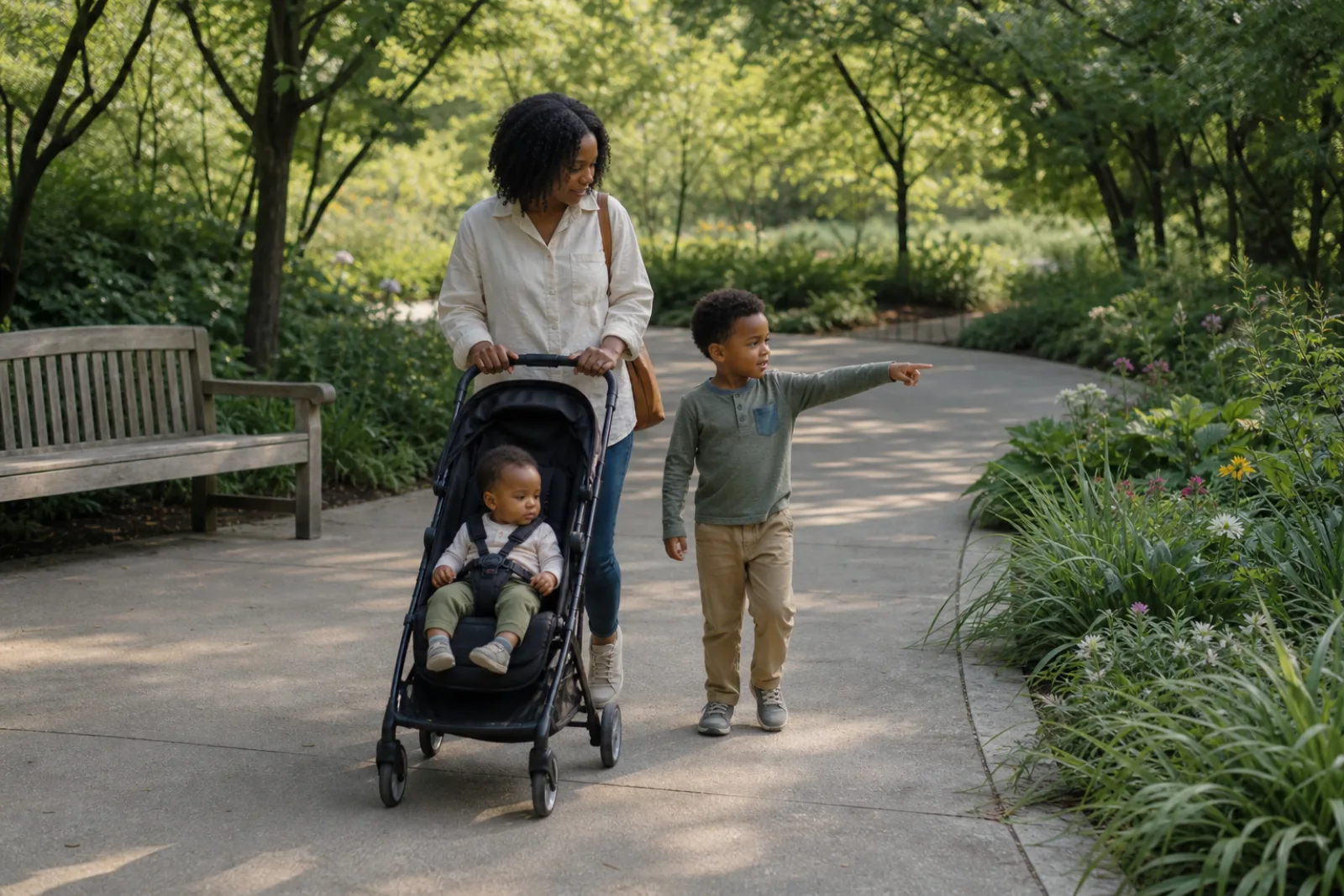
Then look at the surface, path width, slope, shade, benches, food, and the bathroom. Finish with the exit.
Can you cut the loop short when a child is done? The way back is often harder than the way in.
A gentle downhill start becomes a long uphill push with a sleeping child and a full basket.
Quick checks
- Trace the route from parking or transit to the main activity.
- Check surface, width, slope, shade, and stopping places.
- Look at the return trip, not only the first stretch.
Guide 2
A paved park or waterfront loop
Pick a loop whose distance you already know. One mile with shade and benches is more useful than a scenic trail with no obvious turnaround.
Look for recent notes on construction, flooding, broken pavement, steep sections, and bathroom closures. Waterfront paths can be windy and exposed even when it felt mild at home.
Quick checks
- Choose a distance you understand before starting.
- Check construction, flooding, surface damage, and bathroom closures.
- Notice wind and sun exposure on open waterfront routes.
Guide 3
A botanical garden
Gardens often combine smooth paths, shade, benches, bathrooms, and enough to look at if a child wants to get out and walk. Ask for the shortest step-free loop rather than assuming the main visitor route is flat.
Some side gardens use gravel, steps, bridges, or narrow paths. Keep those optional so the outing still works if you stay on the main route.
Quick checks
- Ask for the shortest step-free loop.
- Keep gravel paths, bridges, and side gardens optional.
- Check shade, benches, and the nearest bathroom.
Best options by situation
| Situation | Best option | Why it works | Watch out for |
|---|---|---|---|
| A baby may nap | Smooth garden, museum, aquarium, or waterfront loop | A steady route offers shade and places to pause. | Noise, closing time, and a long return can interrupt the plan. |
| A toddler will ride and walk | A short paved loop beside a playground or lawn | The child can walk on the easiest stretch and ride for the return. | Crowded crossings and long gaps from the car make transitions harder. |
| You have a double stroller | A large garden with a wide main path | The main loop is more likely to have turning room and benches. | Narrow side gardens and small elevators may not work. |
| The weather is poor | A library or museum with close-together facilities | The route stays indoors and can remain short. | Wet-stroller rules and narrow galleries may change access. |
| You want a longer attraction visit | A zoo or aquarium with a mapped short route | One priority exhibit keeps the distance under control. | Hills, crowds, and a long exit can add more effort than expected. |
| You want a free outdoor outing | A marked boardwalk or firm accessible trail | The route can offer nature without rough roots and rocks. | Parking fees, closures, and unpaved sections may still apply. |
Guide 4
A library or museum
Indoor public buildings are a good weather backup when the entrance, elevator, bathroom, and children’s area sit close together. Check whether strollers are allowed in every room and whether busy galleries ask you to park them outside.
At a museum, choose one floor or one wing. Repeated elevator trips can take over the visit.
Quick checks
- Confirm stroller rules for the rooms you want to visit.
- Find the elevator and bathroom before choosing a route.
- Keep the visit to one floor or one wing.
Guide 5
A zoo or aquarium on a short route
Large attractions are not automatically easy. Study the map and choose a small loop with one exhibit you care about, a bathroom, and a place to sit.
Hills, crowded indoor galleries, animal-viewing steps, and long exits add more work than people expect. Ask about rental strollers only if you are comfortable using unfamiliar straps and storage.
Bringing your own usually makes naps and packing more predictable.
Quick checks
- Choose one priority exhibit and one short loop.
- Check hills, viewing steps, crowded rooms, and the exit distance.
- Know where the bathroom and first stopping place are.
Guide 6
A boardwalk or marked accessible trail
Boardwalks and firm, level trails can provide a real outdoor outing without carrying a child over roots. Use the land manager’s current trail page rather than a photo caption that says “easy.”
Check the surface, width, slope, distance, weather closures, and whether the route stays usable after rain. “Accessible” may apply to one section rather than the whole trail.
Quick checks
- Use the current official trail page.
- Check which exact section is marked accessible.
- Confirm recent rain or weather has not changed the surface.
Guide 7
An indoor walking space
A mall, community center, conservatory, or large public atrium helps in heat, rain, smoke, or a low-energy day. Go at a quieter time and pair the walk with one small stop: a children’s area, a snack, a fountain, or a library.
Confirm hours, parking, the elevator, and whether the indoor play area has a place to leave the stroller.
Quick checks
- Choose a quieter time rather than a peak shopping period.
- Pair the walk with only one small stop.
- Confirm elevator and stroller-parking locations.
Guide 8
Choose a route you can shrink
Out-and-back paths and small loops are easier to cut short than a one-way circuit. Before you start, notice the first bathroom, a shaded or indoor place to stop, the point where turning around still feels easy, and any steep section that will be harder on the way back.
If a toddler wants to walk, let that happen on the easiest stretch. Get them back in the stroller before a crowded crossing, a hill, or a long gap from the car.
Quick checks
- Choose an out-and-back route or small loop.
- Name the turnaround point before the child is tired.
- Keep walking time near the easiest part of the route.
Guide 9
Stroller setup and packing
The American Academy of Pediatrics recommends using the harness, setting the brake whenever you stop, keeping bags off the handles so the stroller does not tip, and never leaving a child unattended. Follow the stroller’s age, weight, terrain, and seating limits.
Pack weight low in the basket. Keep water, a snack, wipes, changing supplies, and one weather layer where you can reach them without unloading everything.
Extra weight shows up on the last hill and during elevator transfers.
Quick checks
- Use the harness and set the brake whenever you stop.
- Keep heavy bags off the handles and store weight low.
- Pack only the supplies you can reach and carry comfortably.
Choose without scrolling forever
- 1
Trace the route from parking or transit before you leave.
- 2
Choose the shortest useful loop or indoor circuit.
- 3
Confirm elevators, bathrooms, and changing space.
- 4
Pack only what you need for that route and weather.
- 5
Turn around before tired children make the return harder.
Before you leave the house
- Parking or transit route checked
- Surface and slope checked
- Elevator status checked if needed
- Bathrooms and changing space confirmed
- Weather cover and water packed
- Turnaround point chosen
Frequently asked questions
What places are usually stroller-friendly?
Paved greenways, waterfront paths, botanical gardens, libraries, museums, aquariums, zoos, malls, and marked accessible trails are good places to check. Confirm the exact route because often only part of a venue works with a stroller.
How can I find stroller-friendly trails near me?
Search the park or land manager’s official trail pages for stroller, accessible, paved, boardwalk, or firm surface. Check distance, slope, closures, and recent conditions.
Does wheelchair-accessible mean stroller-friendly?
An accessible route is a useful starting point. Read the published details anyway because width, weather, surface, and stroller policy can still affect the visit.
Are museums stroller-friendly?
Many are, but some restrict strollers in narrow, crowded, or fragile rooms. Check entrances, elevators, stroller parking, coat-check rules, and re-entry.
What should I look for in a stroller-friendly park?
Look for a safe unloading spot, firm path, manageable slope, shade, benches, bathrooms, clear sightlines, and a route you can shorten. Check the return trip, not only the first stretch.
What should I bring?
Bring water, a snack, wipes, changing supplies, and weather protection. Keep the load light, store weight low, and do not hang heavy bags on the handles.