A search for “train rides for kids” can turn up a four-minute park loop or a two-hour heritage railway trip. Check the full ride time before promising either to a child.
Start by choosing the ride length and boarding setup. Then search the operator’s official page. Schedules, tickets, and accessibility can change by day and by train car.
Know which train ride you found
| Ride type | What the visit often includes | Confirm before promising it |
|---|---|---|
| Miniature park train | short loop from one station, open or covered cars | operating days, adult ticket, height rule, stroller parking |
| Zoo or attraction train | ride inside a larger paid venue | admission plus ride cost, queue, last departure, where it returns |
| Railway museum ride | museum admission and a short demonstration trip | ride schedule, crew availability, which train runs |
| Heritage railway excursion | reserved seats and a longer trip between stations | trip length, return journey, bathrooms, food, assigned seats |
Do not rely on a photo of the engine. Open coaches, enclosed cars, narrow benches, steps, wheelchair spaces, and stroller rules vary within the same operator.
Check the ride, the queue, and the full visit separately
A ten-minute ride may require a 30-minute line. A timed ticket may still ask families to arrive early. A museum train might run only during selected hours even when the museum is open all day.
Find these times:
- ticket or reservation time
- recommended arrival time
- expected queue
- time onboard
- turnaround or return time
- final departure of the day
- walk back to the car after exiting
For a short ride, decide how long you are willing to wait before joining the line. If the child would struggle with that wait, choose the first departure, a quieter day, or a place with another nearby activity that does not depend on the train.
Read the child and adult ticket rules
Operators may use age, height, or both. A young child may ride free but still require a ticket. Children below a stated age or height may need a paying adult beside them.
Check:
- minimum riding age
- whether babies may ride on an adult’s lap
- when a child needs their own seat
- height rules for miniature trains
- how many young children one adult may accompany
- whether the accompanying adult buys a separate ticket
- refund or rebooking rules if the train stops running
If another caregiver is taking the child, send the official rule page, not a screenshot of a search result.
Plan the stroller and boarding handoff
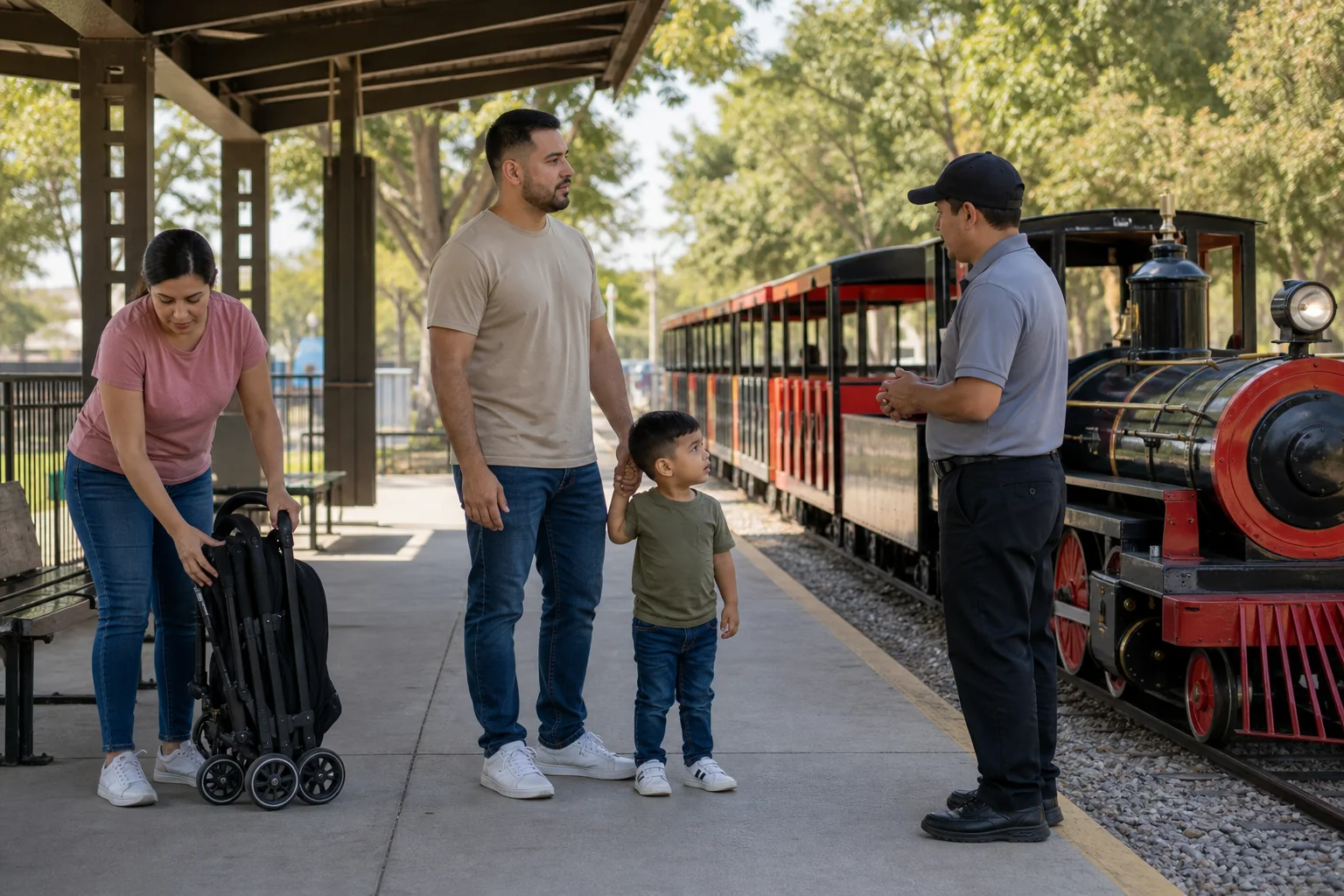
Some small trains cannot carry strollers. Strollers may have to stay at the station while the ride returns to the same place. A longer railway may accept folded strollers in a storage area. Check your operator’s arrangement.
Ask:
- Does the train return to the same platform?
- Is stroller parking supervised, or simply an open area?
- Must the stroller be folded?
- Can bags stay attached?
- How far is the platform from parking and bathrooms?
- Is there time to fold and board without holding up the line?
Keep tickets, phone, keys, medication, and other valuables with you. Remove loose cups and toys before leaving the stroller.
Confirm accessibility for the train that is running
“The attraction is accessible” may describe the entrance or grounds rather than every rail car. Ask the operator about the exact service on your date.
Ask:
- Is there step-free access to the platform?
- Can a wheelchair or mobility device board without a transfer?
- Is advance notice required for an accessible space?
- Can a caregiver sit beside the rider?
- Are boarding ramps operated by staff?
- Does the return platform offer the same access?
Do not treat stroller access as proof of wheelchair access. They use different space, boarding, and securement.
Prepare for sound and motion
Train whistles, bells, brakes, engines, tunnels, public announcements, and cheering passengers can surprise children. Watch a current operator video with the sound on if one is available.
Tell the child what will happen in order: wait at the station, show the ticket, board with an adult, hear the train start, ride the loop, and get off together.
If you plan to bring hearing protection, let the child try it at home first. Ask the operator where you can wait away from the whistle or loudspeaker. Choose an open-air or enclosed car based on the actual equipment, weather, and the child’s comfort. Neither is automatically quieter.
If a child becomes frightened before boarding, step out of the line. Watching one departure from a safe distance may be the whole train activity that day.
Add up the real price
The ride ticket may be separate from parking or admission to the park, zoo, museum, or festival around it.
Calculate:
- admission for every adult and child
- train tickets for riders and accompanying adults
- parking
- online booking fees
- required event admission
- return fare on a railway that does not use a loop
- food during a longer wait or excursion
A free ride inside a paid zoo is not a free outing. A low-cost miniature train can also become a larger visit when other rides sit beside the ticket booth. Decide before arrival which extras are in the family plan.
Weather and operating changes
Outdoor trains may stop for rain, lightning, high wind, heat, track conditions, maintenance, or staffing. A venue can remain open while the train closes.
Check the official operating notice on the day of the visit. If the train is the only reason for going, call when the page does not show current status.
Choose a backup near the same location: a playground, one museum gallery, an animal area, or a short walk. Do not drive to a second unconfirmed train after a long trip.
A simple first-train plan
For a young child’s first ride:
- Choose a short loop that returns to the same station.
- Arrive early enough to watch one train board and leave.
- Use the bathroom before entering the line.
- Keep one familiar adult beside the child.
- Sit where staff direct, and keep hands, feet, and belongings inside the car.
- Leave time after the ride to watch the engine once more before walking away.
Save a long heritage excursion for a child who can manage the boarding time, assigned space, noise, and return schedule.
Frequently asked questions
Can toddlers ride miniature trains?
Many can, but age, height, seating, and adult-accompaniment rules vary. Check the operator’s current policy for that specific train.
Does an adult need a ticket?
Often, yes. A young child may be required to ride with a ticketed adult. Some venues include the ride with general admission. Others sell a separate ticket to every rider.
Can I bring a stroller on the train?
Some trains require strollers to stay at the station. Others store folded strollers. Ask where the stroller goes, whether the train returns to that spot, and what must be removed before boarding.
Are train rides wheelchair accessible?
Some are, but access may depend on the platform, the car operating that day, and advance arrangements. Ask whether boarding is step-free, whether a transfer is required, and whether a space needs to be reserved.
How long are children’s train rides?
Miniature park loops can be only a few minutes. Museum rides and heritage excursions may take much longer. Check onboard time, queue, boarding, and return time separately.
Do train rides run in the rain?
It depends on the operator, equipment, track, and weather. Trains may stop while the surrounding venue remains open. Check the official same-day operating notice.