Guide 1
Pick the play zone before the building
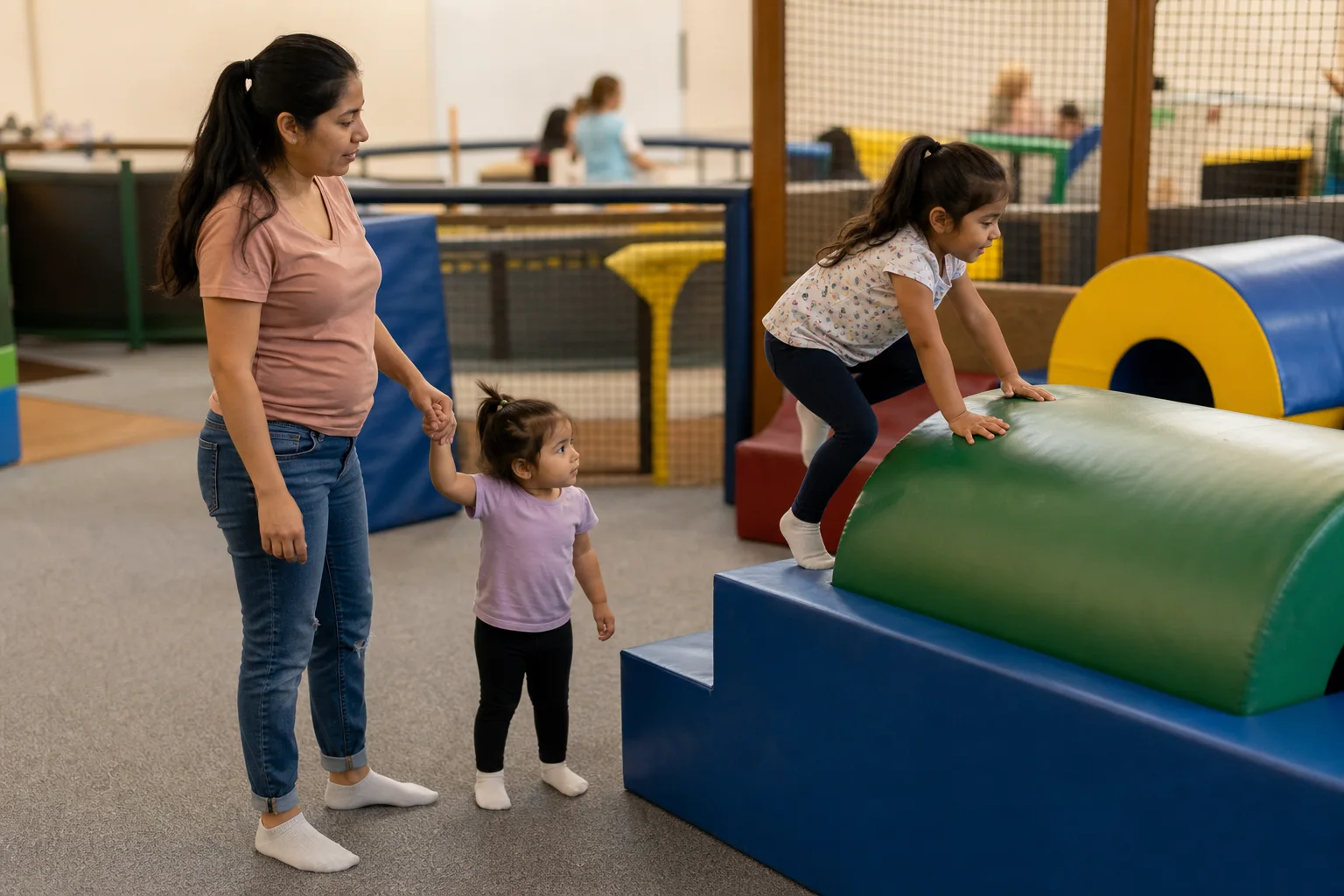
Indoor playgrounds use similar names for very different rooms. One is a padded space for babies and preschoolers.
Another has tall climbing, trampolines, obstacle courses, or arcade games for school-age children. Use the youngest child’s safe play area as the first filter.
“Toddler-friendly” does not always mean there is a protected baby zone.
Quick checks
- Separate zone for babies or toddlers
- Age limits are posted and enforced
- Adults can enter when a younger child needs help
Guide 2
Match the equipment to the children going
Ages 3–5 often do well with low climbing, pretend-play rooms, small slides, building areas, and space to run without mixing with much larger children. School-age children may want longer slides, climbing walls, trampolines, sports courts, or obstacle courses.
Check height and weight rules before promising a feature. For siblings far apart in age, make sure the zones are close enough for one adult to watch both.
Quick checks
- Preschool equipment is more than one token corner
- Older children can use enough of the main structure
- Sibling zones are within the same line of sight
Guide 3
Read the session rules
Some playgrounds sell all-day admission. Others use 60-, 90-, or 120-minute sessions.
A reservation may hold a spot in the building without getting you onto every attraction right away. Check the exact start and end time, how early to arrive, whether late arrival shortens the session, whether play stops for cleaning, re-entry rules, adult admission, and tickets for babies or non-playing siblings.
Add 15–20 minutes for parking, waivers, shoes, bathrooms, and settling in.
Quick checks
- Exact session start and end
- Late arrival and re-entry rules
- Adult and non-playing sibling tickets
Best options by situation
| Situation | Best option | Why it works | Watch out for |
|---|---|---|---|
| Baby or new walker | Separate low-equipment baby zone | Soft surfaces and slower traffic | Older children crossing the area and adult-access rules |
| Preschooler | Low climbing, pretend play, and a protected age zone | Movement and imaginative play without much larger children | Poor age enforcement and tall shared equipment |
| Short energy break | Open play with easy parking | Fast start and no need to stay for a long package | Long check-in and fixed two-hour sessions |
| Grandparent or sitter is taking the child | Venue with an online guardian waiver | The form can be finished before arrival | Rules that require the legal guardian at check-in |
| Lower-cost visit | Sibling rate, adult included, or off-peak session | Fewer add-on costs at the desk | Required extras and online booking fees |
Guide 4
Socks and waivers can stop you at the door
Many indoor playgrounds require socks for adults and children. Some require the venue’s own grip socks.
Others accept any grip socks. Do not assume the rules match the last place you visited.
Waivers may need a parent or legal guardian. If a grandparent, sitter, or friend is taking the child, check who may sign and whether the form can be completed online first.
Keep the socks in the bag you always take to indoor play.
Quick checks
- Grip-sock rule for children and adults
- Who is allowed to sign the waiver
- Online waiver completed before the visit
Guide 5
Work out the whole price
The first ticket shown may cover only one child. Add admission for each child and adult, grip socks, parking, lockers, extra attractions, food, tax, and online booking fees.
For a multi-visit pass, read the expiration date, blackout dates, sibling rules, and whether visits can be shared. Recreation centers may offer resident pricing, and some play spaces run lower-cost toddler hours on weekday mornings.
Quick checks
- Adult and sibling admission
- Required socks, lockers, parking, and fees
- Pass expiration, blackout dates, and sharing rules
Guide 6
Can you actually supervise from there?
Photos taken from above make a structure look open. At child height, tunnels, nets, walls, and separate rooms can block the view.
Look for one clear entrance and exit, seating with a direct view, a toddler area close to the older-child zone, nearby restrooms, and gates children cannot open easily. Staff run equipment and enforce rules.
They are not tracking your child.
Quick checks
- One controlled entrance and exit
- You can see the younger zone from where siblings play
- Bathrooms stay inside or close to the secured area
Guide 7
Check noise, food, and bathrooms
Several birthday parties can change the room quickly. Ask about quiet open-play hours and sensory-friendly sessions if noise, lighting, or crowds matter.
Read the exact adjustments because the label does not mean the same setup everywhere. Check outside-food and water rules, allergy policies, and how close the bathrooms are.
Bring a change of clothes for toilet training or sweaty active play. Choose a library, small museum, open gym, or nature center instead if the main equipment, noise, or split zones will not work for your family.
Quick checks
- Party schedule and quietest open-play time
- Food, water, and allergy rules
- Bathrooms, change of clothes, and a quieter break spot
Choose without scrolling forever
- 1
Match the actual play zones to each child’s age and height.
- 2
Check whether one adult can supervise all children from the same area.
- 3
Read the session, late-arrival, sock, and waiver rules.
- 4
Add adult tickets, fees, parking, socks, lockers, and food.
- 5
Choose another indoor outing if the noise or layout will not work.
Before you leave the house
- Age and height rules checked
- Toddler zone is genuinely separated if needed
- Sibling zones can be supervised together
- Session start, end, and late-arrival rule checked
- Waiver completed by an authorized adult
- Correct socks packed for adults and children
- Adult, sibling, parking, and extra fees added
- Food, water, allergy, and bathroom rules checked
Frequently asked questions
What age is best for an indoor playground?
It depends on the equipment. Some spaces are built for babies and preschoolers; others are mainly for school-age children. Check the age and height limits for the zones you plan to use.
Do adults need socks at an indoor playground?
Often, yes. Some venues require grip socks for everyone on the play floor, including adults who are not playing. Check the rules and bring socks for each person.
Do I need to sign a waiver?
Many private play centers require one. Complete it online before leaving when possible, and check whether the person bringing the child is allowed to sign.
How long should we stay at an indoor playground?
For many young children, 60–90 minutes of active play is enough. Leave time for shoes, bathrooms, and the trip home before they are exhausted.
Are indoor playgrounds good for toddlers?
They can be when there is a real toddler area separated from faster, larger children. Look at the layout and age enforcement rather than relying on the word ‘toddler’ in a description.
How do I compare two indoor playgrounds?
Compare the zones your children can actually use, session length, socks and waivers, sight lines, bathrooms, noise, and the full family price.