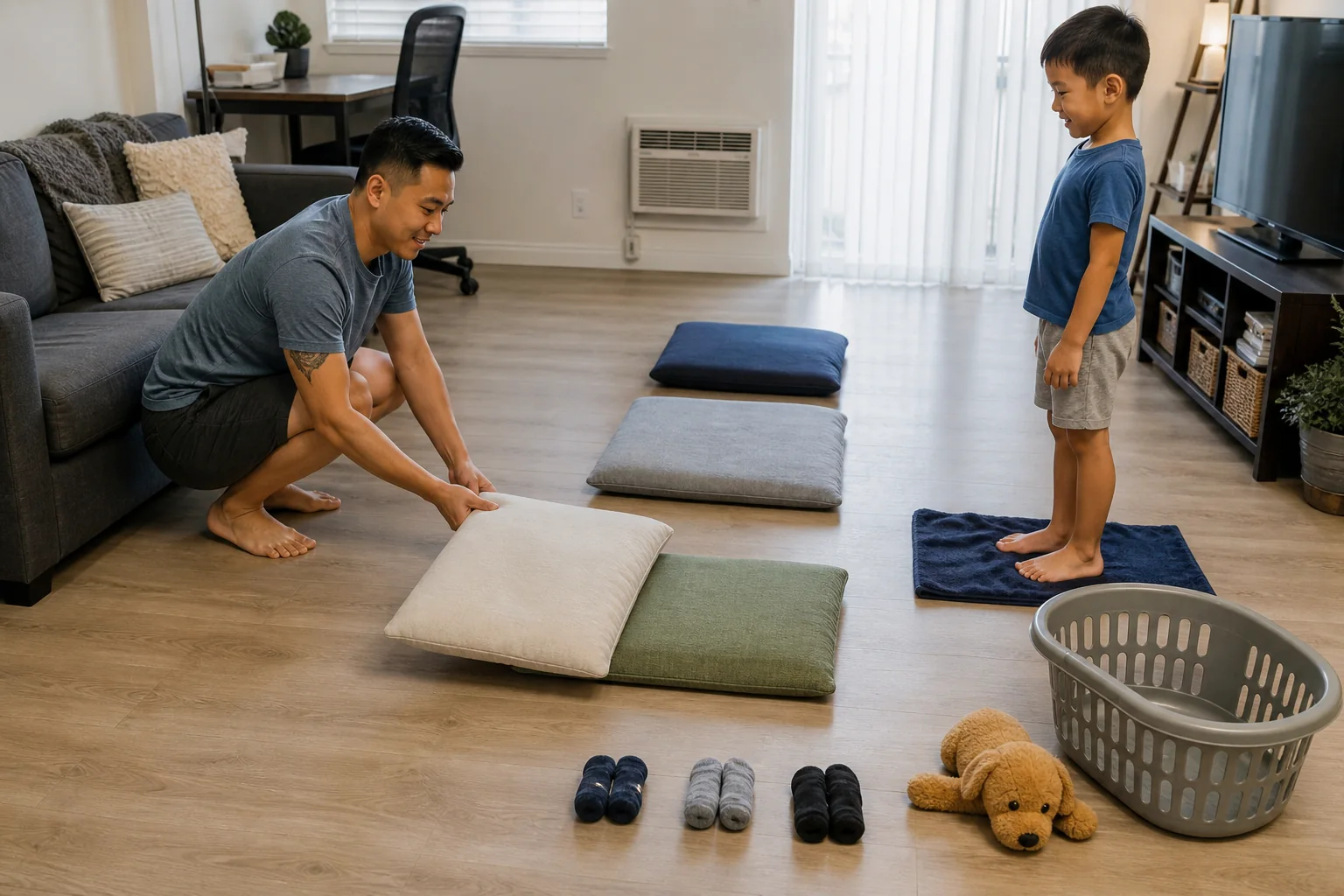
For a preschooler or school-age child, clear a strip of floor and gather two towels, four firm cushions or pillows, a laundry basket, three pairs of rolled socks, and one stuffed animal. That is enough for the six-station course below.
Keep every station at floor level. Furniture is a boundary, not something to climb, jump from, or balance on.
Build this six-station course
Set the stations in a line or around the edge of one room.
1. Start on the towel
Lay one towel flat as the start marker. The child stands there, waits for “go,” and names the stuffed animal they will rescue at the end.
2. Follow the path
Use the second towel lengthwise as a narrow walking path. The child walks from one end to the other without stepping off.
For an easier version, widen the towel. For a harder version, walk heel to toe, or carry a rolled pair of socks without dropping it.
3. Cross the cushion islands
Place four firm cushions flat on the floor with a small step between them. The child steps from one to the next.
Do not stack cushions. Move them closer for a young child, and remove any cushion that slides.
4. Use the crawl lane
Leave a clear lane beside the cushion islands leading toward the basket. The child crawls along it without climbing under a chair or table.
Leave enough room for hands and knees without brushing hard furniture. If the gap is too narrow, replace crawling with a slow walk to the basket.
5. Make the sock toss
Place the basket on the floor. The child throws three pairs of rolled socks into it from a marked spot. Misses are picked up after all three throws.
Move the spot closer or farther instead of switching to a harder object.
6. Carry the rescue home
Place the stuffed animal beside the basket. The child carries it back to the starting towel by walking around the course, not across the active stations.
One round is complete when both feet return to the towel.
Fit the course into a small room
Keep these five actions in one clear patch of floor:
- Walk the towel path.
- Step onto one cushion and back down four times.
- Crawl one circle around the basket.
- Toss the socks.
- Carry the stuffed animal back to the towel.
The child stays in the same open patch while the job changes. That works better than squeezing a long route between furniture.
In an apartment, skip running and jumping. Use slow animal walks, balance, reaching, and tossing, and keep the activity outside your building’s quiet hours.
Change the course by age and energy
| Child or situation | Change to make | Leave out |
|---|---|---|
| Younger preschooler | one towel, two cushions touching, basket close by | timed rounds and complicated sequences |
| Preschooler | full six stations with short directions | stacked cushions and competitive speed |
| Ages 6–8 | carry an object, remember a station order, design one floor-level change | flips, blindfolds, and furniture jumps |
| Mixed ages | two distances for the sock toss; let each child choose | one shared race through the course |
| Low-energy day | walk the path, seated sock toss, stuffed-animal delivery | crawling and repeated rounds |
| Quiet time | slow-motion movement and a whisper-start signal | running, stomping, and loud countdowns |
Add only one change at a time. When the route becomes hard to remember, children watch the adult instead of moving through it on their own.
Run siblings one at a time
One child uses the course while the other has a job:
- starter says “ready, set, go”
- station checker returns cushions to their marks
- sock collector resets the basket
- designer chooses one change for the next round
Switch jobs after each turn. Reset cushions and collect socks between rounds, while nobody is on the course. Keep the waiting child beside the adult, outside the route.
If children want a score, count completed stations or basket throws. Do not reward finishing so fast that they stop controlling their movements.
Do the adult floor check
Before the first round:
- clear toys, pet bowls, cords, lamps, and breakable items
- close access to stairs, kitchens, fireplaces, and exterior doors
- check that cushions and towels do not slide on the floor
- move the route away from sharp corners and glass
- keep pets and younger crawling children outside the active area
- check that the child’s footwear grips the surface during a slow practice round
- explain where the child walks after the final station
Do not tie string across a path, build tunnels from unstable furniture, stack pillows for height, or ask children to jump from a bed or couch. Stop if a towel or cushion slips, the room becomes crowded, or children stop following the route.
Let the child redesign one station
After two or three rounds, ask the child to change one floor-level action. Useful swaps:
- walk around two pillows in a figure eight
- move the basket one step farther away
- carry the stuffed animal along the towel path
- touch three colored toys in a chosen order
- lay the basket on its side and roll a ball into it instead of throwing socks
The adult checks the change before anyone runs it. “No climbing and nothing tied across the floor” are simple design rules children can remember.
Finish and reset the room
Announce the final round before starting it. Afterward, each child returns one type of item: cushions to the couch, towels to their place, socks to a drawer, toys to a bin.
Take a photo of the layout first if the child wants to build it again. Put the room back to its normal walking path before you call it done.
Frequently asked questions
How do I make an indoor obstacle course for kids?
Use floor-level stations with different actions: follow a towel path, step across flat cushions, crawl through a marked lane, toss rolled socks, and carry a toy back to the start.
Can an obstacle course work in a small room?
Yes. Keep the child in one clear floor area and change the action at each station instead of building a long route through furniture.
What household items can I use?
Flat towels, firm cushions placed directly on the floor, a laundry basket, rolled socks, soft toys, and a ball can create several stations. Check every item on the actual floor before play.
How do I make the course quieter?
Remove running and jumping. Use slow walking, careful stepping, animal walks, seated tossing, object carrying, and a quiet start signal.
How long should the activity last?
Run a few rounds while children still follow the stations, then announce one final turn. The usable time depends on age, space, and how often the course needs resetting.
Can siblings race each other?
One-at-a-time turns are easier to supervise indoors. Give the waiting child a starter, reset, or design job instead of putting two children on the same route.